Friday, October 31, 2008

A Tale of two cities: Istanbul and Kolkata

I must confess I did not know much about Turkey or Istanbul before I went there.

A colleague suggested that I take Orhan Pamuk’s ‘Istanbul - Memories and the city’ just before I left.

I hadn’t heard of Orhan Pamuk before. He is a Turkish writer who won the Nobel Prize in literature recently. I bought the book from Crossword and started reading it at the airport.

Frankly I couldn’t relate to what he had written as I began to explore Istanbul. He had written about the filth, sense of melancholy (huzun), poverty, ruined buildings, drab clothes and pained faces.

The Istanbul that I saw (Taksim and Sultanhmet) were the same areas that he had grown up in and written about. What I saw was a city full of vibrant people, walking purposefully, often dressed like super models. I saw elegant, restored buildings. We saw well preserved and well lit up monuments. People who were bright and friendly, hardly depressed or repressed. Roads were clean and yet had a character unlike antiseptic Singapore.

Towards the end of the book Pamuk reveals his first heart break. That made sense. That could have coloured his mind and his world view. We often remember cities through our memories.

Pamuk’s argument was that the Turk’s more or less lorded over the world under the Ottomans. They did not take well to their fall from power after the Ottoman empire collapsed and the Republic was set up. He also wrote about how, Mustafa Kemal Ataturk, led a Westernisation drive for them to move away from the past.
Istanbul must have seen some big changes in recent years as it was quite different from the Istanbul of the fifties to the seventies that Pamuk writes about. Perhaps the Euro Cup which they hosted helped. The government must have led this drive. One could sense the government everywhere in forms of uniformed policemen with machine guns, police vans patrolling the roads or even the mechanized road cleaners.

This set me thinking about my home city of Kolkata. Kolkata was called Calcutta and was the capital of India in the first part of the British rule. Most of the early thinkers, politicians, businessmen, cinema celebrities, writers, poets, most of India's Nobel prize winners, the best academic institutions et al were from here.

Then the capital shifted to Delhi in the beginiing of the twentieth century. Later Kolkata was swamped with refugees from Bangladesh twice (1947, 1970) – during the partition and during Bangladesh’s independence movement. The communists won the local elections and have ruled the state for more than thirty years now. The city buckled under the pressure and just caved in. Despair, ruins, poverty, meleancholy were the order of the day. Since then the city seemed to live more on its past glory and seemed to turn its face away from its ugly present. People would speak longingly of the British. The British prime minister, John Major’s visit in the nineties was seen as its route to deliverance. That didn’t happen of course and other Indian cities such as Mumbai, Delhi, Bangalore left Calcutta behind in terms of liveliness and growth.

Then, like Ataturk propounded in his Westernisation drive, Kolkata too seemed to turn its back on its past in a desperate attempt to ape cities like Mumbai. That was roughly when I left the city (1998).

I see quite a resurgence when I go home to Kolkata these days – splendid flyovers, spurt of Bengali restaurants with Bengali food no longer being considered uncool, new housing properties, an acceptance of Bengali culture with clothes like kurtas in traditional designs, Bengali rock bands and so on getting popular.

Yet the differences are not as stark as what I saw in Istanbul now verus what Pamuk had written about it. I wonder what that sort of transformation would take… enlightened citizens? Administrative will? Or is it something more dramatic ?!


Tuesday, October 28, 2008

A tale of two cities: New and old Istanbul


The two main areas of Istanbul, Sutanahmet and Taksim, best reflect the multiple identities of Istanbul. They bring alive its unique mix of the old and the new.

We stayed in two hotels in the Taksim area. Taksim square and the road which emanates from it, Istiklal Cadesi, ends in the Beyoglu area. Our first hotel, the stately Marmara Istanbul, was bang on Taksim Square. The second one, the hip Marmara Pera, was at the Beyoglu end.

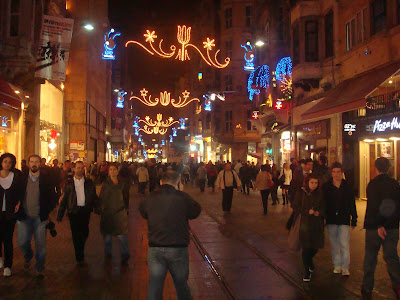
One could call this the ‘new’ face of Istanbul. Istiklal is a sort of a walking street which is lined with old buildings which one associate with 19th and early 20th century Europe. These buildings had been converted into fancy shops (clothes, books, antiques, shoes) which housed most international brands.


Kainaz took advantage of the cold to make me buy her some nice European looking stuff such as a woolen cap and a light blue trench coat. The styles were different from what you get here. Apparently she had to dress up for coffee! The irony is that I had bought the most ridiculously expensive jacket in the history of jackets from Ed Hardy as an anniversary gift but the annicersary (22nd October) was right at the end of the trip. I couldn't have her becoming an ice maiden before that could I after 7 years of sticking together through years of counting the change.


Istikal Padesi had a range of eateries - Mac Donalds, Starbucks, Burger King, etc and local kebab, kofte, piaz, delis, doner (Turkish shwarma) & oil dreched burger stalls and fancy restaurants including those in Cisek Pasaji, a very elegantly restored flower market.


There were some grand churches and an ambling tram reminiscient of late 19th century Europe.

The street was crowded late into the night with hip, smartly dressed young Istanbullus walking purposefully. It is a young and lively place and fitted into our image of Western Europe. A number of cities in the world have these ‘be there or be square’ places. The ones which come to mind are Colaba in Mumbai, Park Street in Calcutta, Sukhomvit in Bangkok and Thamel in Kathmandu and, very losely, Baga at Goa.


The Taksim area was home to Kainaz and me for 6 days and was clearly our preferred part of the city. I loved the wonderful mix of modernity in a classical shell


Orhan Pamuk, in his book, Istanbul, refers to Taksim and Beyoglu as places where the Greek, Jew and Christian minorities of Istanbul used to live. This probably explains the West European feel to the area. He also says that the houses here were ransacked during riots in the 1950s. My guess is that the government must have restored this area since then. If they have, then it is a wonderful example, which I wish could be done in India. They look very different from the filth, poverty and ruins which Pamuk writes about. The change, obviously, is dramatic since then.

The other key area is the old city or the Sultanahmet area. In fact this seemed to be the preferred base of most tourists that we met. It had most of the ‘must sees’ of Istanbul within walking distance.

You first come across the Haghia (pronounced Aia) Sophia which was built by King Justinian. It was apparently the principle Church of Christianity when Constantinople was the centre of the Christian world. This was later converted into a mosque when the Ottomans took over and you see Arabic inscriptions inside the church. Haghia Sophia was converted into a Museum by Mustafa Kemal Ataturk, the founder of the Turkish Republic in the middle of the twentieth century. I felt that this was a nice solution to the religious impasse between the Christians who built the Church and the Muslim majority who occupied it over the centuries.


I wonder if anyone in India would come up with such an enlightened solution for the Babri Masijid Ram Janmabhoomi complex. This could turn this area of religious dispute into a monument for the world to admire.

Close to the Haghia Sophia is the Topkapi Palace. This is where the Ottoman Sultans used to live and rule the world. It is a huge complex built over 4 courts (areas). Kainaz had decided that we should explore the palace ourselves with the help of the Lonely Planet which her colleague Shushobhan had lent us to discover Turkey with. We decided on this was after we felt that we were quite rushed by the tour guides in most of the other places and could not really take in the atmosphere. I was a bit sceptical about the absence of guide but must admit that she made the right decision.


Well we ended up spending a full day here walking from court to court, awestruck by the Sultan’s reception room, the library, the huge, huge Royal kitchen, the treasury which had a throne which Nadir Shah had taken from India and the 86 carat Spoonmaker’s diamond which nearly blinded one with its brilliance.


We then bought another ticket to go to the harem and spent an hour there lost in the inner world of the sultan. We looked at the empty rooms and windows and wondered about what must have happened behind its closed walls. I am sure they must have a lot of interesting stories of the sultans and his favourite women. I wonder who ruled whom. But most have taken some skill to manage them.


In between all this we had a lovely lunch at the very posh, hundred year old, Konyali restaurant (estd 1907) in the Topkapi palace complex. It was a classy, fine dining experience which we enjoyed by the Bosporus. Loved the lamb goulash. We shared a main dish with fries, tea and ayran (butter milk). It was too expensive to order 2 dishes or wine! But that's what happens if you gate crash into the Sultan's party.


If we had gone in a guided tour then they would have crunched all of this into an hour. Well, as they say, the wife is always right.


The Blue Mosque, which was built by the Ottoman Sultans to over shadow the Haghia Sultan, is synonymous with Istanbul. This is a marvel in medieval architecture with its imposing dome and delicate mosaic work. Inside the mosque there was a lovely, red carpet which was heavenly to walk on. The mosque was meant to inspire awe... and it did!


In between the Blue Mosque and the Haghia Sophia you come across what the tourist books describe as the ‘Hippodrome’ where chariot races used to happen. I was looking forward to seeing a Coliseum like structure out of the Gladiator or Asterix comics. Actually it is a regular metalled road with an ancient column. A bit disappointing to say the least.


What’s not disappointing is the 500 year old underground cistern, the Yerebetan Sarnici or the Basilico Cistern. This was restored in the 1990s. This is not a part of standard tours. Kainaz chanced upon it while reading the Lonely Planet in a café in the Grand Bazaar. We were quite awestruck when we went there. It was an experience straight out of Indiana Jones. You go down a regular looking staircase and come onto a huge hall like area which is the water reservoir. There are a line of pillars with a couple of them having two heads of Medusa. The atmosphere is very different. It is wet and cool with water dripping from the ceiling. The tasteful, soft lighting adds to the magic in the air. You can even see fish swimming in the water as you make your way through the walkways. There was a tiny café there where we stopped to have a cup of coffee. This reservoir used to supply water to Istanbul centuries back.


Soon after the Blue Mosque and the Yerebetan Sarnic you come to another 500 year old marvel, the Grand Bazar. This was a bazaar set up by the Sultans for people to trade. It is divided into various sections such as those for carpets, porcielen, antiques, etc. This is quite an interesting Bazar to look at with its ornate columns and ceilings. It gives you a feeling of the past far away from the glass and chrome malls today. Haggling is common here. We were called into a carpet shop, where we sipped some apple tea, saw many carpets and then firmly said no and left. It is fairly genteel and well organized. You don’t feel pressured unlike what people claim about the market in Cairo. One good place to eat here is the Pedeliza restaurant which we discovered thanks to the Lonely Planet book.


What to buy? Here’s a commonly known secret. Take in the atmosphere in the Grand Bazar and then head to what I call the ‘good bazar’ for shopping. This is the Spice Market or the Egyptian market which is a couple of tram stations away from Sultanahmet. It is less grand, has fewer shops, but has the same stuff as the Grand Bazar at half the price and is about 400 years old. The tram station for this is Eminonu. The Bosporus cruise starts from here too so you can always check it after the cruise. We did most of our souvenir shopping – tee shirts, apple teas, spices, dry fruits, evil eye trinkets – from here. The salesman are quite friendly, they push their stuff but aren't overbearing. We might a friendly young man called Jeman whom we bought most of our stuff from.


Close to the Grand Bazar is the Cimerlati Hamam allegedly designed by Sinan, the architect who designed the Blue mosque. More on that later but it is definitely avoidable unless you are a masochist. I am still too shaken by it to write about our harrowing experience there. Both Kainaz and I needed some stiff vodkas to recover from it that night.

As you see, most of the tourist spots – Haghia Sophia, Blue Mosque, Yerebatan Sarnici, Topkapi Palace, Grand Bazar - are within walking distance of each other at Sultanhamet which is also known as the ‘old city’. There are a number of restaurants and hotels there. As I said earlier, most people we met were staying there.


However, the ‘new city’, the Taksim area seems more like a modern city. What I would recommend is to stay at Taksim. Go over to Sultanahmet to take in the sights and then come back and walk the streets of Istiklal and Beyoglu from Taksim in the evening.


So here you have a quick overview of Istanbul. It is almost as if it is a tale of two cities – the modern, buzzing, European Taksim and the Ottoman palaces and Occidental, medieval, majesty of Sultanahmet. Why choose between the two? After all you can get the best of both the worlds at Istanbul.

Notes :
1. The two, Taksim and Sultanahmet, are fairly well connected by public transport. You go by an underground metro from Taksim to the next stop, Kabbatas. Here you buy another ticket or Jeton and take the tram to Sultanahmet Station. The same works while returning. The locals are very helpful and they help you out if you think you are lost. That’s how we came upon this route. Each way takes half an hour and a round trip costs 5.6 Liras or 3 Euros or about Rs 180 per person. A taxi would take much more. The trains and trams are crowded by are a cake walk for anyone who has travelled on Indian trains or buses.


2. The only toursity place which is slightly away from Sultanahmet is the Dolmabahace place. This is the ‘modern’ palace where the Sultans lived post the 18th century. You can only go here with a tour group which, in a hurried 45 minute round ,shows you the opulence of the palace including the world’s largest chandelier. Turkish Nobel Prize winner, Orhan Pamuk, in his book ‘Istanbul’ says that he used to sneak kisses with his first love and muse. here. I wonder whether that’s why years later you now need to go with an organised group and can’t walk around by yourself.


3. Some indicative prices of things mentioned:
- Dolmabahace tour/ Blues Mosque + Haghia Sofia/ Topkapi Palace – each half day tour costs about 52 USD per person
- Entrance to Yerabatan Sarnici is about 20 Turkish Lira or 10 Euros per person
- Entrance to Topkapi Palace (should be done without a tour) is about 20 Lira/ 10 Euro pp and the entrance to the Harem is another 15 Lira/ 8 Euros pp
- Hamam (hamam+ soap+ oil massage) – 80 Liras/ 40 Euros pp down the drain. This price fluctuates and was higher the next day. This is also the only place in Turkey where tips are openly solicited
- Turkey tee shirt – 20 Lira/ 10 euro in Grand bazaar. 10 Lira/ 5 Euro in the Spice market. 8 Liras after bargaining.

- 100 g apple tea: 1 lira after bargaining when bought in bulk in the Egyptian market

- Pedalisa lunch for 2: 20 -25 liras, 12 euros

- Konyali lunch: 50 liras, 25 euros - skimpy lunch - sharing main course, no alcohol and so on. They have sandwich counter which is cheaper.
- Kofte piyaz deli lunch for 2 - 15 liras, 8 Euros
-- Cisek Pidesi dinner lunch with vodka, no dessert - around 35 liras (17 euros)

- Roadside hamburger - 4 liras or 2 euros

- Starbucks cappuccino - 4.5 liras or 3 euros for small (tall) Gloria's was a couple of Liras more

Ottoman Rhapsody


In retrospect it seems strange that we spent so many hours fretting over our holiday plans. Now it seems that Turkey was the natural choice. It was everything that we had wanted from our holiday. And much more. We loved every moment of it. I am still trying to get over it. For example I went to the Bagel Shop to have a goat cheese Bagel this morning simply because I was missing my breakfast cheese fests from Turkey.

We wanted a holiday which was different from our Far Eastern ones and we got it. The glass and chrome malls were replaced with lovely shops in the 19th century buildings of Taksim Square and the 15th Century Grand Bazar and Spice Bazars. The hot and humid weather was replaced by a pleasant chill which made one feel that was one was moving around in natural air conditioning, even outdoors.

We wanted history and we got to see the the awe inspiring early Christian cave churches of Cappadaccia from the 3rd Century AD, the amazing underground cities of the Hitites (I don't know how they stayed there for 3 months, I ran out after 3 minutes), the Hagia Sofia, the principle Church of Christrianity when Constantinople, as Istanbul was called then, was the centre of the world, the epic Blue Mosque from the 15th Century and the Topkapi Palace from the same period when the Ottoman Empire ruled a large part of Europe, Asia and Africa and the Dolmabahace Palace from the time when the Ottomans wanted to Westernise themselves in the 18th century and the mysterious 15ht century water reservoir, the Basilico Cistern. We relived a bit of modern history as we stayed in the former Greek streets of Beyogulu where there was civil strife in the 1950s and we had dinner in the refurbished flower market of Cisak Padesi.

It was also a holiday of historical discoveries. I had grown up studying about Rome, Greece, Egypt, Mesopotamia and then Western Europe. I had no idea of the magnitude of the Byzantine Empire and its successor, the Ottoman Empire.

I craved for open spaces and I got 3 hotel rooms where I could look into the sky, one from which we could see the sea and another from which we could see the amazing Cappadoccian terrain. We took a beautiful cruise on the blue Bosporus, drifting by the prettiest of houses and took a hike through the Cappadoccia valleys. We saw the most magical terrains which made one wonder whether this was all a dream.

We wanted to be pampered and stayed in 3 lovely hotels - the grand dame, Marmara Istanbul with its chandeliers and wood and brass theme, the luxurious boutique cave rooms of the Museum hotel in Cappadoccia and the funky Marmara Pera in Istanbul which was petite but perky with its purple and green theme.

We came across some of the friendliest people in the world who were ever willing to help one out. Language was rarely a problem. If we came across someone with limited English then he would go and find out someone who could help. We also saw some of the most smartly dressed people right from those on the streets to even the hotel staff or the chauffeurs.

And. of course, the food. We had some of the most delectable food. Right from the local fare in the delis of Istiklal Cadesi to the gourmet fare in the Museum Hotel restaurant, the Le'la and in the Konyali Restaurant in the Topkapi Palace. We had a most memorable anniversary dinner in Keravan Serai to the beat of the belly dancers and while being entertained by the one of the most talented linguist we had ever seen. We had the dainty local apple teas and Turkish coffees in equally dainty cups and had lovely cappuccinos and cikkolata frappuccinos in Starbucks and were tickled when we got our loyalty card at Gloria Jeans, Istanbul.

We were so happy that we kept smiling through the holiday as we explored Turkey through our friend's Lonely Planet Guide.

Through all of this I read Orhan Pamuk's Istanbul to get a sense of the soul of the city. Then I thought I must jot down my immediate memories before getting into more detailed posts.

So keep watching this space for more.

Tuesday, October 14, 2008

To be or not to be....off to Turkey

After months of indecisiveness we are setting for our annual wedding anniversary holiday (22nd October) early tomorrow morning. We are off to Turkey - Istanbul and Cappadoccia.
Our earlier international holidays to Thailand and Malaysia were fairly simple and we did not did take much time deciding on the destination.
But this is how it happened this time:
  1. It's our seventh anniversary so we should be some place special
  2. Let's go to Egypt
  3. Hotels seem dicey, let's got to Turkey
  4. Prices don't seem that different to let's do Prague, Vienna, Budapest
  5. Too many visas why don't you go to Switzerland, prices are similar
  6. It will be too cold let's look at Turkey again
  7. Egypt hotels aren't too bad, I know of a couple of good places. Us - OK let's book that
  8. Egypt hotels aren't available during your anniversary (22nd, October) as there is a car rally
  9. OK let's look at Turkey
  10. Which hotels?
  11. Oh can you give us Switzerland options too?
  12. If you recommend Marmara at Istanbul, are the bathrooms good there? My wife is very particular! The whole holiday hinges on this.b
  13. We don't want to go too many places. We are keen on history. No amusement parks or packaged tours please
  14. OK knock of Anatolia, let's look at Istanbul, Cappadoccia and Pammukale for Troy and Ephesus
  15. Flying to so many places in Turkey is too expensive, can we drop one? Which one?
  16. Ok Cappadoccia and Istanbul it is
  17. Hold on, we can't spend our anniversary in airports...let's leave Bombay a day earlier
  18. Cave hotels at Cappadoccia? Sounds interesting. Go ahead. Deluxe rooms? Go ahead

Of course my finances collapsed well before the global crash. But at least our holiday plans were settled.

Point 7 is where Arvind Tandon of Faraway Places (+91 22 26335070) stepped in. He counselled us when we were completely at sea. He had been to both Turkey and Egypt and could speak authoritatively on both which gave me a lot of confidence. He then put us on to his colleague Dilber Mistry. Dilber saw us through points 7 to 18, patiently answering the emails I'd fire by the minute and responding to our changing plans without our murmur. She too had been to Turkey and could advise us from experience including on specific stuff on hotels, cost of eating and so on. That was a great help.

The experience so far has been exactly what we would like from a travel agency and something tells me that the trip will be fantastic too. In fact Arvind and Dilber were sweet enough to insist on meeting Kainaz and me today before we left so that they could brief us in person and answer any questions that we had. I was quite impressed and touched by that.

I know look forward to returning on the 25th with lot of interesting stuff on Turkey to put on faraway diaries. I don't know if the coincidence struck you but Arvind's agency is called 'faraway places'.

Do write in with your comments. I love reading them and will publish them once I am back on the 25th of October.

Monday, October 13, 2008

A city for all seasons: Durga Pujo in Mumbai

I moved to Mumbai ten years back. So technically it is not a 'faraway place' I have made this lovely city my home and it has welcomed me with open arms.

But there is one time of the year when I feel very home sick. That is during Durga Pujo, the biggest festival of us Bengalis. The first time I realised how far away I was from home was when I had visited the Durga Pujo at my adopted home of Bandra at Mumbai ten years back. That's when there were boulders in my throat.

There were just too many memories of Durga Pujo in Calcutta - the year long anticipation, the new clothes, the hair cut two weeks before the festivities, no studies, countless hours spent with friends, the puja in my building - Debjan Apartments, the food, the pandal hopping through the city with friends - all of these came back back in a rush of black and white images as I stood at the Bandra Pujo, fresh out of Calcutta.

I have tried to make it back to Calcutta most years since then during the Pujos. Though I must say that a bit of the magic has gone with the friends I grew up with being available only on Facebook and Orkut, if at all.

I didn't go back this year. But I did see a couple of nice Pujos at Mumbai. I went to the Balkanjibari pujo for the first time at Santa Cruz on my way to the prayer meetings for Mamma (Kainaz's grandmom who had just passed away). I said a prayer for her. The setting was just right as the Pujo was very well organised. I got a a fairm amount of peace and quiet in the pandal that afternoon to be alone with my thoughts. A far cry from the community Pujos of Calcutta which are like big fairs with streams of people pouring in. This reminded me of the pujo in our apartment complex in Calcutta.


I went to the Bandra Pujo on the penultimate night of the festival. Again, I entered the premises peacefully. Something one could not imagine in the big pujos of Calcutta. I went to the prayer area and was there for quite a while. I am usually not very religious and don't leave offerings at religious places. But this year I left some money at the Santa Cruz pujo for Mamma and at the Bandra pujo in appreciation of the way Bandra has welcomed me over the last decade.

I waited for almost an hour for Kainaz to join me. During this time I was seeing the entertainment programme which was going on and was part of the Pujo celebrations. It reminded me of the the programmes we would organise in our pujo at Debjan Apartments, the skits, the songs, the 'orchestra' to which we all danced.

Once Kainaz came, we made a beeline for the food stalls which are a part of our Pujo pilgrimage at Bandra. As you can see from my picture I really enjoyed the lovely food and downed chicken rolls, mughlai paratha, kosha mangsho (mutton) and sweets with great glee.
The prices were a bit extreme (Rs 50 for a roll) but I guess that's the price one paid for nostalgia. The quality of the food was largely pretty good. Though it's smart to stick to the snack items which are fried in front of one instead of the cooked meals.

The most famous Pujo of Mumbai used to be the one at Shivaji Park. I have been there a couple of times. It is quite huge and is filled with people. It reminded me of the Md Ali Park pujo in Calcutta as it is one of the older pujos and the crowd was comparatively less up market than the Bandra one. The equivalent of the Bandra Pujo would be Maddox Sqaure or Jodhpur Park in Calcutta which have a comparatively younger and trendier crowd.

I guess the most famous Pujo in Mumbai now would be the one at Lokhandwala. This is supported by the Times of India now and is patronised by the filmi or Bollywood crowd. I have never been there yet. The famous Lokhandwala traffic snarls are too forbidding.

And if you are at Bandra you don't really need to go anywhere else for anything in Mumbai!

Friday, October 10, 2008

A bathroom for Mrs K: Baga hotels

There are a few memories which rush in the moment one thinks of holidays. For me trips to Kolkata means eating great food at home and out, Bangkok brings back memories of some of the liveliest streets in the world, think KL and one thinks of glass and chrome malls and then there are the lazy river rides of the Sunderbans and the peaceful, lonely trails of Matheran.


One big part of our holidays at Baga, Goa, is finding the right place to stay. North Goa, where Baga is situated, doesn't have the branded hotels such as Holiday Inn, Taj, Leelas, of South Goa. You have a variety of hotels which are all quite different from each other. What we look for is location (close to the beach and and close to our favourite restaurants), clean rooms AND clean bathrooms. The last means the world to Kainaz.


So our trips have seen Kainaz look at a number of rooms before settling on one. Didn't matter that we could be tired and bedraggled from the journey from Mumbai. We have spent hours walking the Baga Calangute stretch checking hotel after hotel after feeling dissatisfied with where we were staying. Kainaz is very picky. This has happened so many times now that it is as much a part of our Baga ritual as is having Baskin Robbins ice creams after fish baffat at Brittos or having a pork chilly fry on the shack the day we leave or going there in the first place on my birthday. The latter three are my obsessions just as clean toilets and hotel rooms are Kainaz's.


I will never forget Don Juom's which is the clean, two storied family run place opposite the Church at Baga. I had stayed there during my first trip to Baga with two of my friends. Somehow the three of us managed to share the tiny, very basic but clean and neat room for a princely sum of 100 Rs per head. This was ten years back. Frankly I don't remember the bathroom but I went there recently to show the place to Kainaz and IT seemed fine. Especially for those bachelor days where the idea was to just have fun away from draconian bosses and restrictive paying guest digs in Bombay where one shared a room and a toilet with many others.


Kainaz and I stayed at The Paradise Village the first time we went to Baga together on her birthday. This was a cluster of cottages which were not bad but not good either. The walls were damp, the bathroom mouldy and gloomy and the location was a bit off as it was at the end of Calangute and therefore quite far from Baga.


Our later trips were always in February during my birthday. This is peak season at Goa when rooms are at a premium.


The next time was carnival time and a friend help us find a place at The Saffron Resort as most places were booked. It was the same deal as Paradise Village, cottages with dank rooms and this was even further off from Calangute.


So we begun the first of our famous walks looking for a new hotel down the streets of Baga. We despaired as we saw that most of the good ones - Ronil, Cavalla Inn, Villa Goesa - were full and that the ones available were hell holes.


That's when we chanced upon the Goa Holiday Resort. This place was opposite Infanteria and was owned by Punjabis settled in the UK. The room available was neat and clean and the bathroom was small but shiny and polished. The AC rates was the then Baga average of Rs 1500 or about 30-40 USD. We liked the place and booked ourselves without a thought the next year. We were shocked out of our wits when we reached. The room was dirty, walls were grimy, shower curtains were stained, basin was chipped and the restaurant which served steaks was replaced by a vegetarian restaurant. Then we discovered that the ownership had changed.


Kainaz and I begun our desperate alternative hotel hunt the first night itself. By a stroke of luck we got a room at Villa Goesa. This was a place where my boss from those days had stayed. We never got a room earlier as they are always full. This is a lovely place. The entire property is well landscaped and neat. The staff is very friendly. The rooms are airy, bright, clean and they have an elegant white paint and dark wood theme going. The bathrooms were neat and clean and the plumbing sparkled. The location was lovely as it was by the road in between Baga and Calangute. You came out of the property and walked through their private coconut grove and hit a slightly peaceful part of the beach. The rates were reasonable too and were around Rs 1700 - 2000 or 50 USD.


We loved the place and stayed there during our next trips. Paradise found? End of hotel searches? Not Really!


Our luck ran out when we went for our fourth trip this February. The internet booking agent had messed up the booking and the hotel claimed they didn't know we were were coming. This after we had paid in full from Bombay. So we got a gloomy room, with a groaning aircon, creaking bed and a hand shower in the bathroom which was quite geriatric. We raised a stink and then got a room which was better but where the bathroom flooded. We were mighty peeved! This too on our fourth stay there and after recommending the hotel to all.

So the Karmakars set off on their hunt again. That's when we chanced upon a boutique hotel called Waters in the lane behind the Subway sandwich shop. This tiny two storied hotel had about eight rooms. It was very tastefully done and the rooms were named after various colours. We got the red room. This had a chirpy red wall, a red candle, four coaster beds, a very nice and large bathroom with red tiles. We just loved the place and ran out of Villa Goesa which had betrayed us and moved in there.

The little stuffed toy which we picked up from the Mumbai airport with its red shirt was quite at home there. The pace was a steal as the room was a couple of hundred Rs cheaper than Villa Goesa and the room was much much better. The staff was very helpful too. It turned out that it was run by a couple of young people, one of whom was from Calcutta! The place was so lovely that it really a bit of magic to the holiday. In fact we cancelled our air ticket, lost money, paid more for a new ticket and stayed an extra day once we moved in here. That's how much we loved Waters. I am keeping my fingers crossed that we can go there next year and that it doesn't let us down.

After all this bathroom did meet Mrs K's approval!


There is another lovely place which is slightly more expensive. It is called Casa Alexia. It is a villa with lovely rooms with elegant, antique furnishings. This is beside the old people's home on the Baga Road. The only problem is that we have never seen any guests there and it does look a bit spooky. Perhaps the Sunset Boulevard of Baga?

PS. Despite our recent bad experience I would not write off Villa Goesa completely. It is closer to the beach and it is a larger property with lawns and a swimming pool. This would be a better place to go to if you are with kids. Just book in advance and try to book directly or through a site called www.nivalink.com who are quite efficient

Friday, October 3, 2008

Mumbai budget Eats


A reader of my food blog, finely chopped, wrote in yesterday asking for suggestions on where to treat an out of town friend at Colaba or Bandra at Mumbai. She requested me to keep in mind that she'd be footing the bill so requested me to keep a tight budget in mind.

Here's what I wrote to her:

I have tried to think of places which are economical yet seem special as you are treating someone. Some of these places don't serve alcohol. Alcohol jacks up the price.

List of around Rs 750 (USD 10) for 2 places:


Bandra:-

  • Carter Rd Gully: Karims (he might get to see Malaika Arora there, I ate here last night a lovely Muslim dinner for two cost us Rs 315/ 8 USD),Kwik Wok (Oriental), Open Affair (no theme), Maybe (continental, very basic tastes), Crepe Station (ditto) all without alcohol...finish off with gelato or (romantic?) walk by the sea
  • JATC (salads, pizzas, pastas, sand wich, subs) no alcohol but very alive
  • 5 Spice: alcohol but expensive, food very value for money - one main dish more than enough for . Try - chilly chicken, burnt chilly rice or noodle, Thai curry. Desserts are 125 plus but very good - MY PICK
  • Basilico, Out of the blue, Red Box very nice but will cross 1000 minimum
  • If you are willing to slum it, Khaane Khaas, well within 500 lovely food, clean but spartan seating. Try tandoori chicken, black daal,jeera chicken, fish tikka. Great service, no crowd

Colaba/ South Bombay

  • Churchill - lovely continental food, average price of 200 per dish -must have sausages in firecracker sauce, prawn newberg, ice tea. Long queues though
  • Mocambo - beside Citibank in Fort. Lovely ambiance. Insist on theParsi menu. Conti stuff is 300 plus. But Parsi/ Goan stuff is around Rs100 per plate and can be positioned as unique to Bombay. Must trys -dhansak or pulao, daal, bheja cutlet, if adventurous - Ox's tongue. MY PICK given its a treat and has to be economical and should give a flavour of Bombay. You get alcohol too. Ice teas are very good, same management as Churchill
  • Leopolds - very cult specially if he has read Shantaram. Sit downstairs though as upstairs is very expensive. Chinese is good and potions are large
  • If he doesn't mind no meat or no alcohol take him to the Gujarati Thali places such as Golden Star at Charni Rd. Quite ornate, unique,food is plenty and prices are fixed (around 300 per thali)

Readers: please add in your suggestions. The brief is inexpensive yet not 'cheap'

Related Posts with Thumbnails